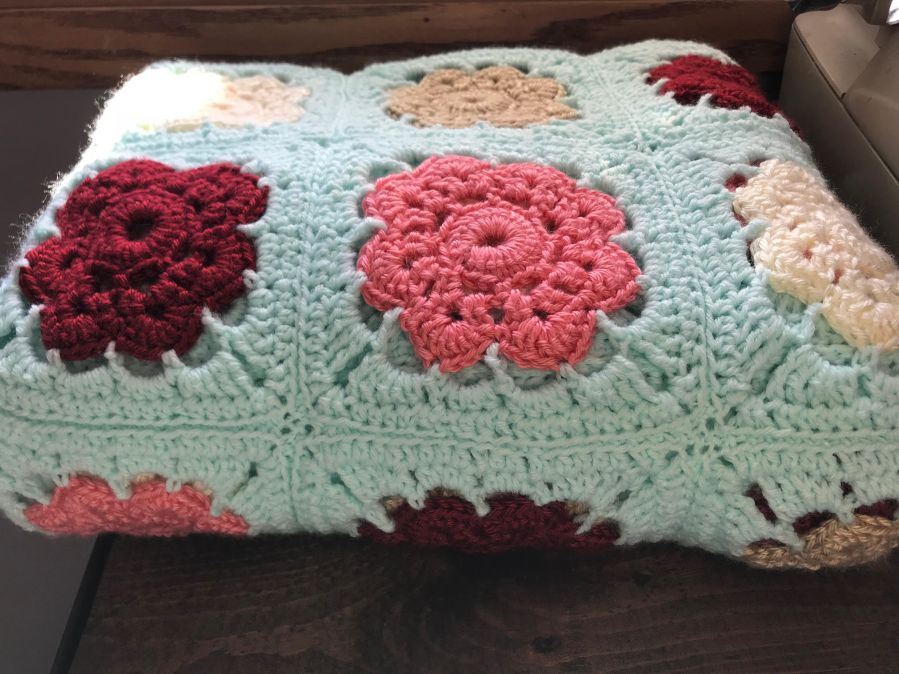
My First Afghan: the virtues of granny squares and making mistakes

When I first started out crocheting, I loved to crochet flowers because they were small, simple, quick, and satisfying to create. The idea of a large project was a far too intimidating to start. That’s when I discovered a pattern that took a flower and put it into a square which could then be attached to more and more squares to make one big, final blanket: thus, my discovery of the granny square. This being the first big project of mine, I’ll be honest to say that it took a while. It took me about three years of on-again-off-again crocheting to complete. Even then, I made many mistakes along the way that I learned from and even came out to be fortuitous.
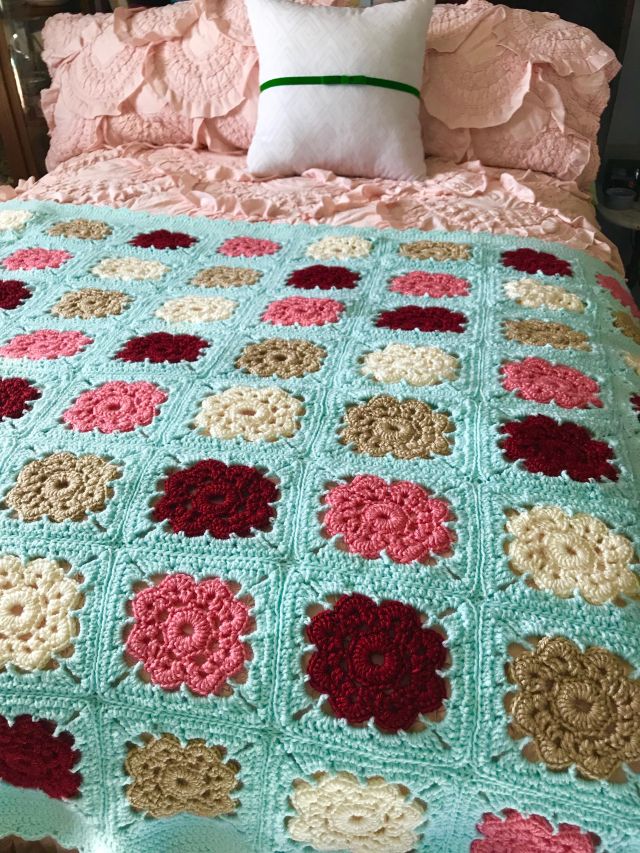
blanket on bed

Another virtue of crocheting with the granny square technique (and why I think I prefer it) is that it keeps you interested. Even though an entire project may take a long time to create, the pieces themselves are accomplishments of their own. Even though I love to crochet, I tend to get bored of a project after a while, so being able to switch up the colors and whether I was doing a flower, or the square border, was great. It’s also easy to make small, short term goals that really keep me going until the big goal of a finished product is within reach.

The Materials:

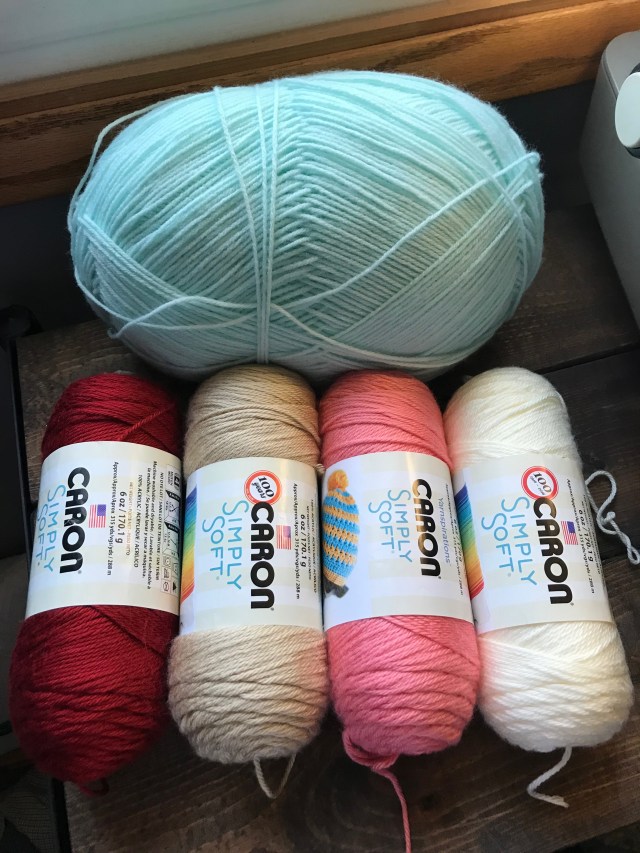
  • Lion Brand Pound of Love Yarn in Pastel Green (it looks more turquoise to me; I used just over 2 skeins)
  • Caron Simply Soft Yarn in Autumn Red, Bone, Strawberry, & Off White (I used about 3 skeins of each)
  • Size 4.25 mm crochet hook (this is smaller than recommended on the yarn, but it just seemed to work better for me)
IMG-7320

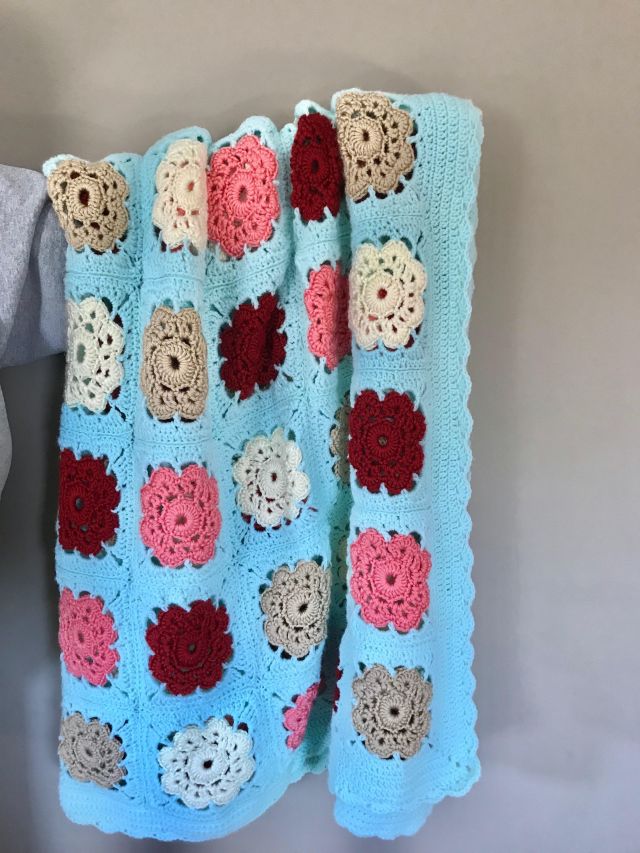
The materials I end up using are never an exact science and rely more on a gut feeling. I was buying yarn and was attracted to the shiny, softness of Caron Simply Soft yarn. I also loved how the reds and the pinks of the yarn for the flowers contrast with the turquoise/green and yet are all balanced by the neutrality of the white and tan.
corner

The Pattern:

  • The pattern for the flower itself can be found here. 
  • A step-by-step picture tutorial can be found here.
  • The pattern for the square border can be found here. 

Now, I did follow the patterns pretty closely except for one mistake early in my crocheting days. I did not do a double crochet normally (yarn over, insert in loop, yarn over and pull through, yarn over and pull through two, yarn over and pull through two). Somewhere along the line I started doing it wrong and didn’t notice until I was halfway through the project. I would yarn over, insert in loop, yarn over and pull through stitch and through one loop on hook, pulling it to the approximate length of a double crochet and then yarn over and pull through two loops on hook. It’s a variation that I recently discovered in my post about my first crochet hat to be the herringbone stitch. When I noticed this error, I made a Maybelle flower with a normal double crochet and was surprisingly less pleased. Doing it incorrectly actually made the flowers have a little more body and puffiness in the middle and the petals. The normal double crochet pattern was very thin and the hole in the middle was a lot larger. So, I continued to do the incorrect stitch in the middle and on the petals only, opting for the correct double crochet stitch everywhere else in the pattern (which made it look neater and more stable).
on arm

Arranging and joining:

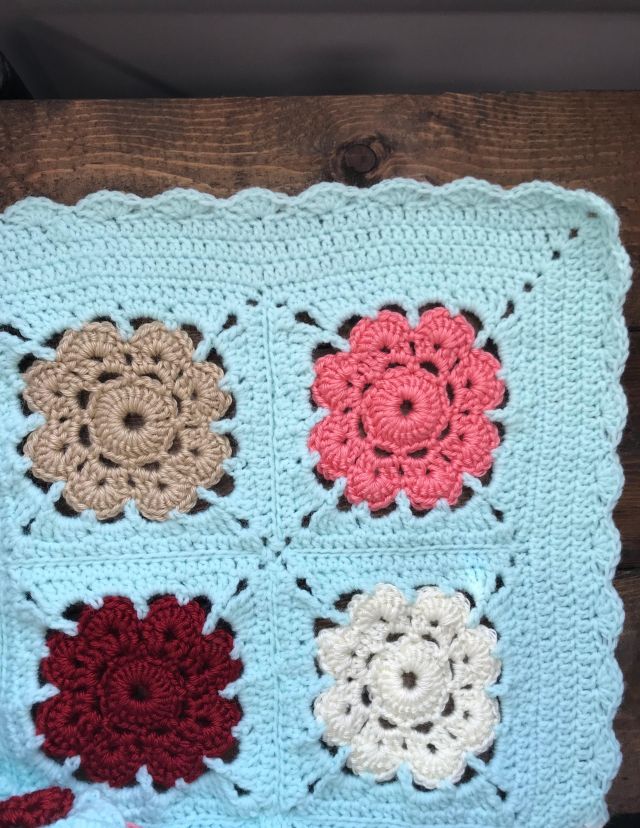
I arranged the colors in 2 x 2 squares so that each color was represented. I assembled them in strips of these squares so that it was a strip of two rows of the Maybelle squares and then attached the strips together. Then in between these squares, flowers of the same color would be diagonal each other. My main goal was to not have any flower of the same color directly next to each other.

I joined the individual squares together by placing the right sides together and slip stitching through the back loops of the edge of the squares. Here is a very good, detailed tutorial of exactly what I did.
four blocks

Finishing:

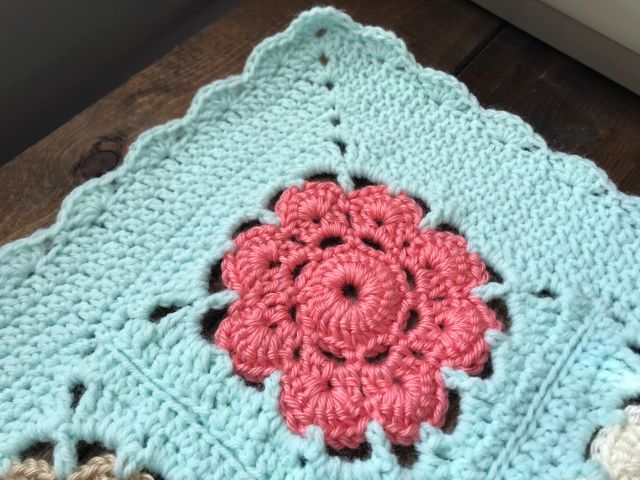
I finished the blanket with a border: three rows of half double crochet. At each corner I would half double crochet two then chain two then half double crochet two all in the same stitch to make it pointy. The final row of edging was meant to mirror the look of the petals of the flowers. I followed a simple shell pattern of single crocheting in whatever stitch you end up at, skip two, double crochet five in the third stitch, then single crochet in the third stitch from that and repeat. I had to fudge it one or two stitches around the corners. I didn’t necessarily count my stitches and plan it out, but I always did a petal of five double crochet in a corner. It turned out really well because it matches the flowers but is less emphasized in their shape. The whole Afghan turned out to be 8 rows by 10 rows of single Maybelle squares and 52″ by 60″ with the border.

What I have learned from jumping into crochet without really knowing what I’m doing is that there’s really no mistake that can’t be fixed or worked into the project. You might even like it better in the end than if you hadn’t made all those mistakes along the way. It’s a very Bob Rossian message. Just because you aren’t an expert doesn’t mean you can’t succeed and it won’t work out in the end.

Bob-Ross-Quote-2


Grandma’s Recipe: Chop Suey nostalgia

Even now, I can imagine the smell of my grandmother’s kitchen when she makes Chop Suey: all onions and celery. It has become a smell I love; the smell of a fresh cut onion that lingers on your hands on in your clothes after cooking. Chop Suey is one of my Grandma’s staple specialties; something I have sorely missed on the weekends I didn’t get to go home from university. I had been putting off making it for fear that it just wouldn’t taste the same. It wouldn’t have that same magic grandma-can-make-anything-taste-good flare. So, this past week I embarked on my journey in making this family famous recipe.

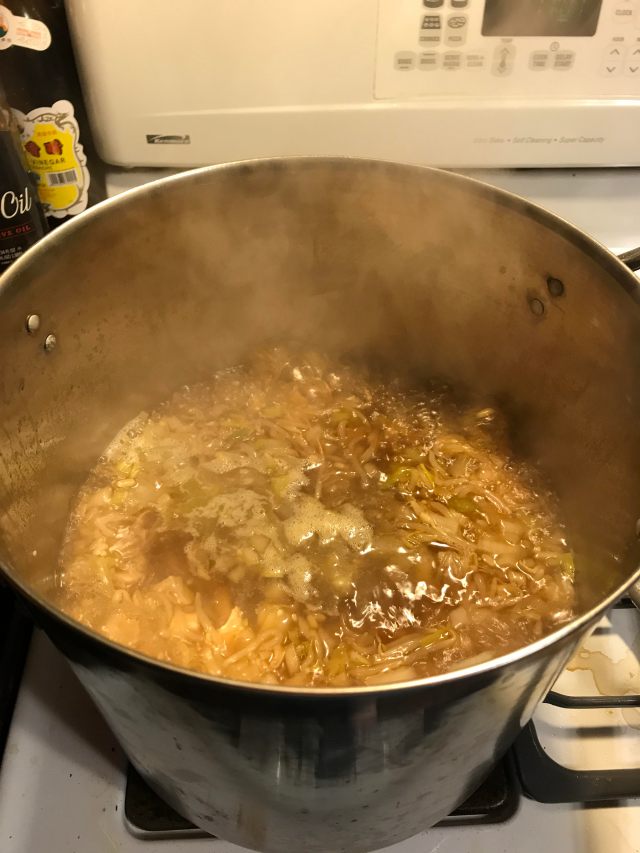
Chop Suey is something I had never heard of outside of this one dish my grandma makes and every recipe I’ve found online is a little different. However, the simplicity of the dish as she makes it is its winning quality. It’s essentially a soup of lean, browned pork, onions, celery, and canned bean sprouts all flavored by a few dashes of soy sauce. Once all the flavors of ingredients have combined and melded together, you spoon it over crunchy Chow Mein noodles. All in one bite you get the salty broth, the soft vegetables, the crunch of the noodle, and the chewiness of the tender pork. It’s a recipe that requires a little bit of intuition because, as my grandma writes it, some of the specifics are not so specific. It speaks to the fact that she’s made it so many times, all the steps have become obvious in their repetition as just about everyone’s favorite Sunday dinner dish.

chop suey

Pictured above is a large stock pot with all the ingredients getting a good simmer.

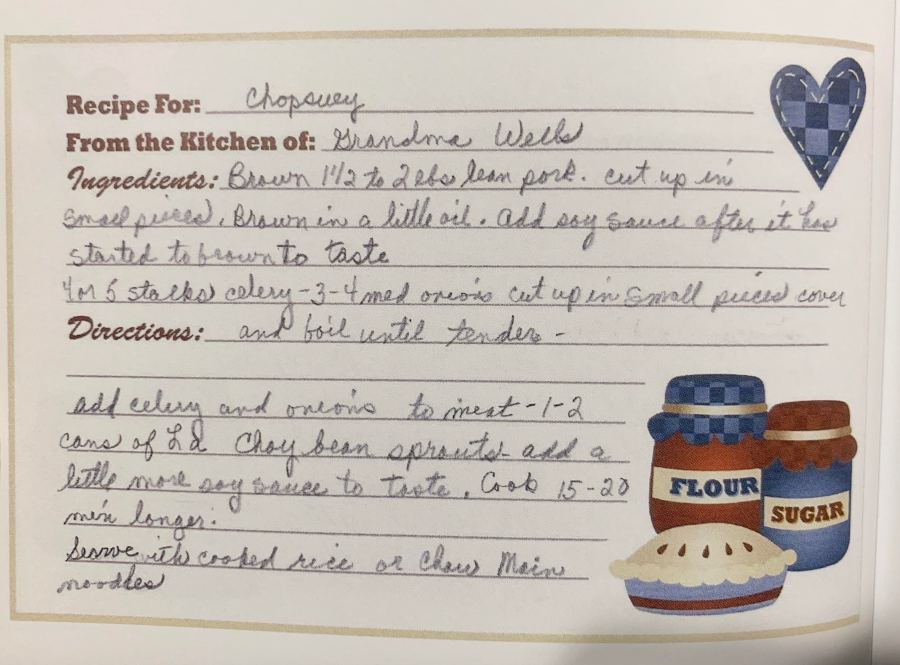
Chop Suey by Grandma Wells

Below is the recipe written out and annotated by me with some of the things I did.

Ingredients:
1 1/2 - 2 lbs lean pork
4 - 5 stalks celery, diced
3 - 4 medium onions
1 - 2 cans Choy bean sprouts
soy sauce

Directions: 
1. Dice the pork and brown it in some oil. Add a few dashes of soy sauce.
(I added some pepper at this point too). 
2. Add onions and celery to a large soup pot to boil in either water or
broth (I used both. I also added some minced garlic.)
3. Add pork when browned and the cans of bean sprouts. Add more soy sauce 
to taste. Boil/cook for about 15-20 minutes.
4. Serve with cooked rice or Chow Mein noodles. (You can add more soy 
sauce to your personal taste at this point as well.)

My First Hat: a weekend crochet project

From the beginning of my crochet career about four years ago, I had avoided making a hat for fear of its difficulty. I thought there was mandatory “decreasing” and fancy, intricate yarn and hook tricks that would be too tedious for me to follow. However, after a cold week where the temperature dipped to single digits, I figured I’d give it my best go; the hat I had just wasn’t cutting it. I ended up finding a pattern with no decreasing that was quite simple to follow. I am also quite happy with the finished product, even after making some mistakes along the way.

I found this pattern that was relatively simple and beautiful. First, it has you crochet the main body of the hat in a rectangle, stitch the finished ends together to make it a cylinder, and the cinch the top together to form the top of the hat. The stitch used here is termed a herringbone stitch that I actually discovered myself in my early crocheting days and before I knew it had a name by doing my double crochets incorrectly. It creates an almost bumpy texture. To finish the hat, a border is added at the bottom and a pompom on top. However, I made a few adjustments to this pattern to accommodate the yarn I had on hand.

yarn and hook

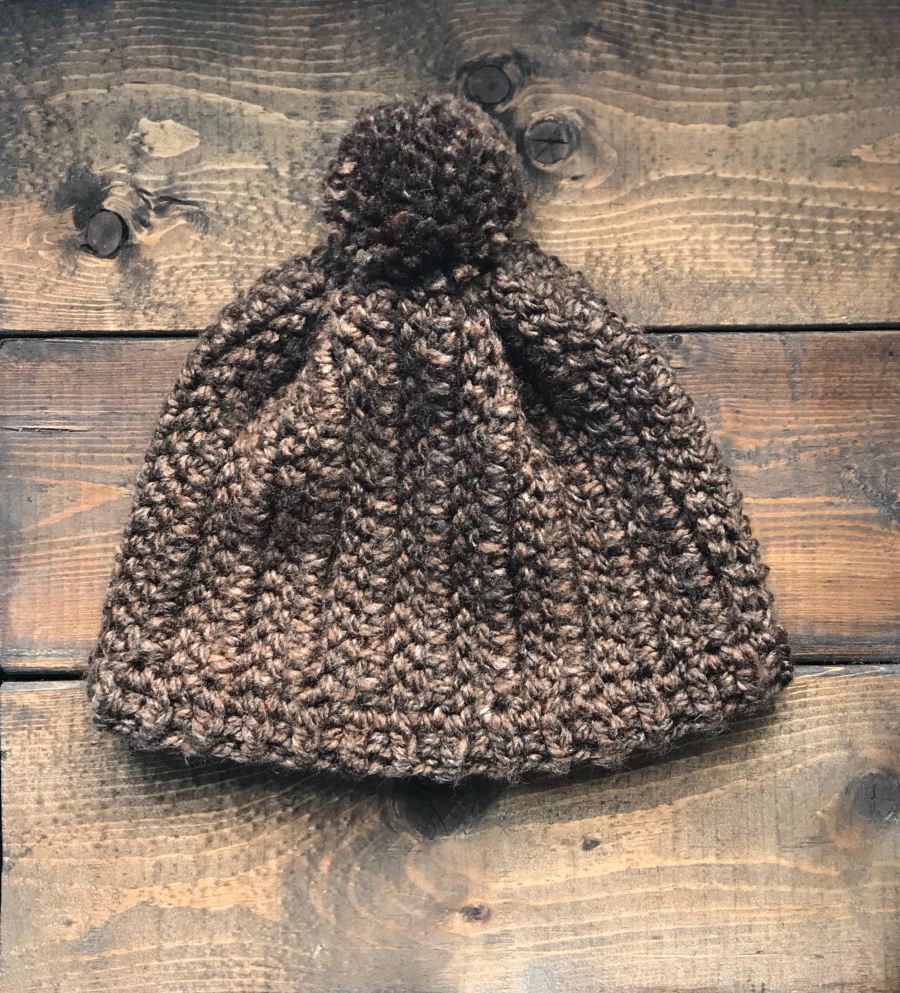
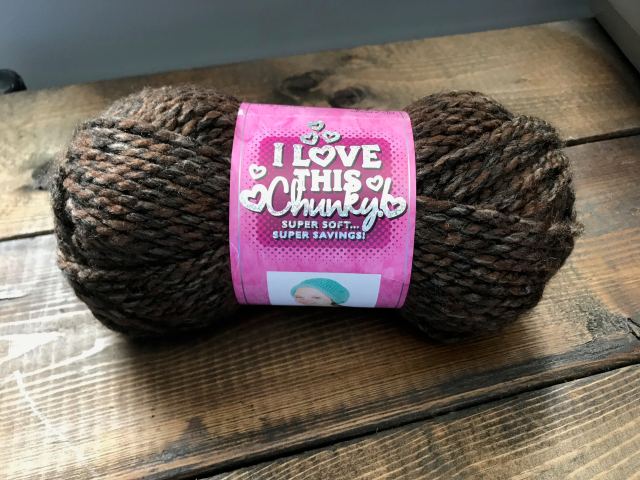
I used the I Love This Chunky yarn pictured above and a 6 mm hook even though it calls for a 6.5 mm. It is a mottled, rich brown yarn with specks of black and other various black/brown hues throughout. The pattern called for a bulky weight yarn and an 8 mm hook. If I were to redo this pattern, I would use a bigger hook so it would be a little looser and not so stiff. Since the pattern calls for a slightly bulkier yarn, I chained 20 instead of 15 which made it a little longer so I was only able to do one row of the front-post and back-post stitch without making the hat too big. In doing this hat again, I would stick to chaining 15 and then add more rows of the border if necessary to get it to the correct length. I love the way alternating front-post and back-post stitches created a ridged pattern. I also had to use a needle and thread to secure my wobbly pompom, but maybe that just means I need to look into how exactly to attach pompoms in the first place.

All-in-all, I love my new brown hat, with its varying specks of black and different shades of brown. It matches both my beige/tan scarf and my black coat. Its sturdy because of the bulky yarn, but also so warm and soft. The hat I wore before continually left an imprint of ridges on my forehead if I wore it too long, but this one is comfortable and roomy. Even if it isn’t perfect, it’s a work of my own. I learned a lot along the way and now have the pride of knowing I made the hat that keeps me warm on my long walks across the college campus.